What Is Casino Slot RTP and Volatility?
RTP and volatility answer two different questions about a slot. RTP answers: how much of wagered money does this game return over time? Volatility answers: how does it return that money, steadily or in bursts?
RTP Defined: The Long-Term Payout Percentage
RTP is the percentage of all wagered money a slot pays back to players over a very large number of spins. A slot with a 96.00% RTP returns an average of €96.00 for every €100.00 wagered. The remaining 4.00% is the house edge. RTP is a theoretical figure calculated across millions of spins and does not predict your return in any single session.
Volatility Defined: The Risk Meter of the Game
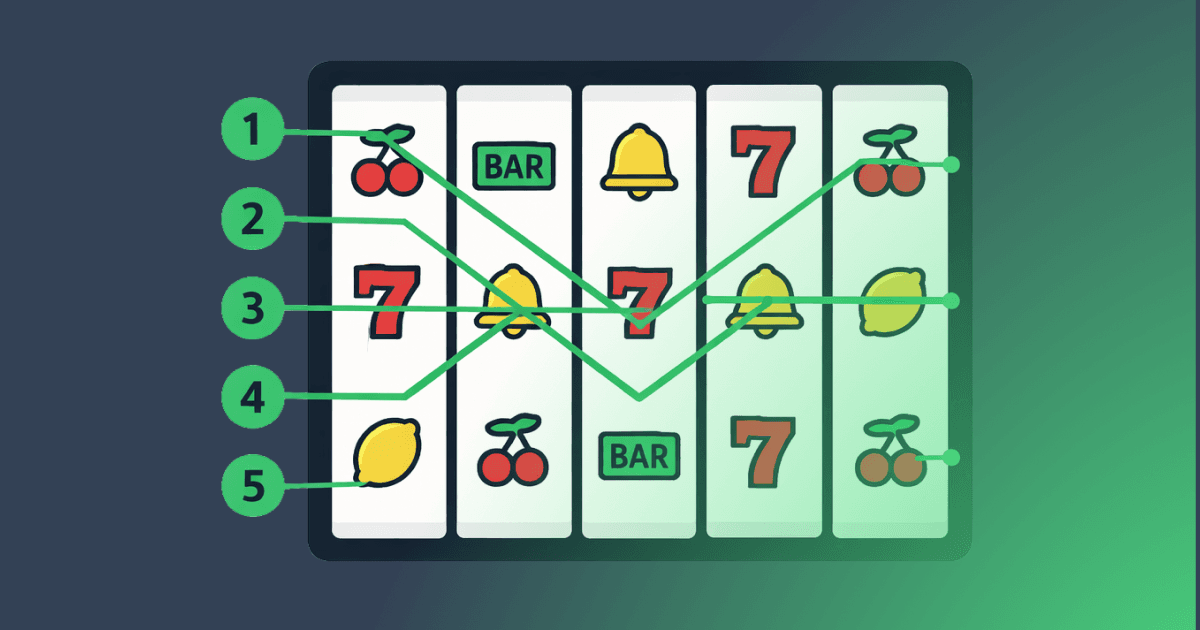
Volatility (also called variance) describes the risk level of a slot. Low volatility games pay out frequently in smaller amounts. High volatility games pay out rarely but in significantly larger amounts. Medium volatility falls between the two extremes. Volatility is not usually stated as a single number; you identify it from the paytable structure, the max win potential, and the game developer's documentation. Payline structure is one of the clearest indicators. For a full explanation of payline types and how they signal volatility, see online slot paylines.
The Key Differences Between RTP and Volatility
RTP and volatility are independent metrics. A slot can carry a high RTP and high volatility simultaneously, or a low RTP and low volatility. Treating one as a substitute for the other is the most common strategic mistake in slot selection.
How RTP Differs from Volatility in Game Mechanics
RTP is set by the game developer and can be adjusted within a permitted range by the casino. It governs the total money returned over the lifetime of the game. Volatility governs the distribution of that return across individual sessions. Two slots can both carry a 96.00% RTP but behave entirely differently: one might pay 40 small wins in 100 spins; the other might pay one large win in the same 100 spins.
Why High RTP Does Not Mean Low Volatility (And Vice Versa)
A slot can return 97.00% of wagered money (high RTP) while delivering that return almost entirely through rare bonus rounds (high volatility). Conversely, a 94.00% RTP slot can pay on almost every spin (low volatility) while steadily eroding your bankroll across each session. Always evaluate both metrics together, not as a substitute for each other.
The Four Player Archetypes: Matching Your Style to Slot Metrics
Most slot players fit one of four archetypes. Knowing yours makes the RTP and volatility combination you should target immediately clear.
- The Grinder (Low Volatility / High RTP): Prioritises extended playtime and consistent small wins. Target RTP above 96.00%, low volatility. Browse low volatility slots to find verified options at your casino.
- The Hunter (High Volatility / High RTP): Accepts long dry spells for the chance at a significant win. Target RTP above 96.50%, high volatility. A larger bankroll is essential. See high volatility slots for games suited to this approach.
- The Balanced Player (Medium Volatility / High RTP): Seeks a reasonable mix of consistent returns and moderate win potential. Target RTP above 96.00%, medium volatility.
- The Casual Player (Low Volatility / Standard RTP): Prioritises entertainment and bonus feature frequency over long-term mathematical value. RTP matters less; a fun base game and accessible bonus rounds matter more. For an introduction to how base games and features work, see how to play slots.
How Casinos Influence RTP and Volatility
Volatility is fixed by the game developer and does not vary between casinos. RTP is different. Licensed casinos can configure RTP within a permitted range set by the provider, which means the same slot can carry a meaningfully different RTP at different operators.
Configurable RTP: Why the Same Slot Has Different Percentages
Many popular slots ship with multiple RTP settings. A game might offer configurations at 94.00%, 96.00%, and 98.00%. The casino chooses which setting to activate. A 2.00% difference in RTP translates to a 50% reduction in house edge. Over 500 spins at €2 per spin, the difference between 94.00% and 96.00% is €20 in expected losses. FindMyRTP scans partner casinos to show which operator currently offers the highest configured RTP for a specific slot.
The Role of Game Providers in Setting Volatility Ranges
The casino slot providers who build these games, including NetEnt, Pragmatic Play, and Play'n GO, set volatility at the design stage. It is baked into the mathematics of the paytable and cannot be altered by the casino. A high volatility slot remains high volatility regardless of the operator. This is why volatility research focuses on the game itself, while RTP research must factor in the specific casino.
How to Find the Best Casino Based on Slot RTP and Volatility
Choosing a slot is only half the decision. Choosing the casino offering the best RTP configuration for that slot is the other half.
Using FindMyRTP to Compare Casino RTP Settings
Enter the slot name in FindMyRTP and the tool returns the RTP each partner casino has configured for that game. You can compare directly and select the operator offering the highest available RTP for the slot you want to play. Rather than assuming a casino offers the developer default, you see the actual configured figure before committing to a session. For a deeper explanation of what RTP means and how it is calculated, see what is slot RTP.
Identifying Casinos That Consistently Offer High RTP Configurations
Some operators consistently configure games at the higher end of the permitted RTP range. Others consistently use the minimum. Tracking this across multiple games gives you a picture of which casinos are structurally more player-friendly. Choosing a high-RTP casino for each game compounds into a meaningful statistical advantage over time.
Strategic Synergy: Combining RTP and Volatility for Optimal Play
The most effective slot strategy combines both metrics rather than optimising for one alone.
Bankroll Management: Matching Your Budget to Volatility Levels
High volatility games require a larger bankroll to sustain through dry spells before a significant win lands. Budget for at least 200 to 300 spins at your chosen stake before expecting meaningful returns from a high volatility game. For low volatility games, 50 to 100 spins is typically sufficient to observe the normal return pattern. Setting a hard loss limit before each session is essential regardless of volatility.
Session Goals: Aligning RTP Expectations with Playing Time
RTP is a long-run figure. In a single session of 100 to 200 spins, variance dominates and actual returns can diverge substantially from the stated RTP. Setting realistic session goals, such as extending playtime, triggering the bonus round, or reaching a specific profit target, is more useful than trying to match the RTP within a single session. Match your goal to the appropriate volatility level before choosing a game. For a full guide to applying this in practice, see how to win online slots.
The Ultimate Comparison: High RTP vs. High Volatility Slots
Feature | High RTP Slots | High Volatility Slots |
|---|---|---|
Primary focus | Long-term value (lower house edge) | High-risk, high-reward potential |
Win frequency | Frequent, smaller wins | Infrequent, larger wins |
Bankroll needed | Lower bankroll suitable | Higher bankroll required |
Best for | Players seeking longevity | Players chasing max win |
True RTP variance | Typically stable across casinos | Often varies significantly per casino |
Session experience | Steady, predictable rhythm | Extended dry spells punctuated by peaks |
Conclusion: Mastering Your Slot Experience
Using Knowledge of RTP and Volatility to Play Smarter
RTP tells you the value of the game over time. Volatility tells you the experience you will have along the way. Using both metrics together, selecting a high RTP game at the configuration offering the best payout rate and matching it to a volatility level your bankroll can sustain, is the most data-driven approach available to any slot player.
Start Your Informed Journey with FindMyRTP
FindMyRTP removes uncertainty around RTP configuration. Instead of assuming a casino offers the standard game RTP, you can verify the actual setting before you play. Search any slot, compare the RTP across partner casinos, and make an informed choice based on data rather than assumption. You can also use the Slot rtp checker to discover recently released titles with RTP data already published.
Frequently Asked Questions About Slot RTP and Volatility
What is more important, RTP or volatility?
Both matter, but for different reasons. RTP determines long-term value: the lower the house edge, the less you lose per euro wagered over time. Volatility determines your short-term experience: how frequently wins land and how large they tend to be. Prioritise RTP for value, then choose volatility to match your bankroll and playing style.
Can a slot have high RTP and high volatility?
Yes. Many popular slots combine a high RTP (above 96.00%) with high volatility. These games return a strong percentage over the long run but deliver it through infrequent large wins rather than frequent small ones. They require a larger bankroll and more patience than low volatility alternatives.
How do I find the true RTP for a slot at my casino?
Use FindMyRTP. Enter the game name and the tool shows the RTP each partner casino has configured for that specific slot. This is the only reliable way to confirm the actual configured RTP rather than the developer's default figure, which your casino may or may not be using.
Does volatility change if I play a slot in demo mode?
No. Demo mode uses the same game mathematics as real-money play. The volatility, RTP, and paytable are identical in both modes. Demo mode is a reliable way to observe a game's volatility profile and bonus frequency before committing real money.
Are there slots with 100% RTP? Is that a myth?
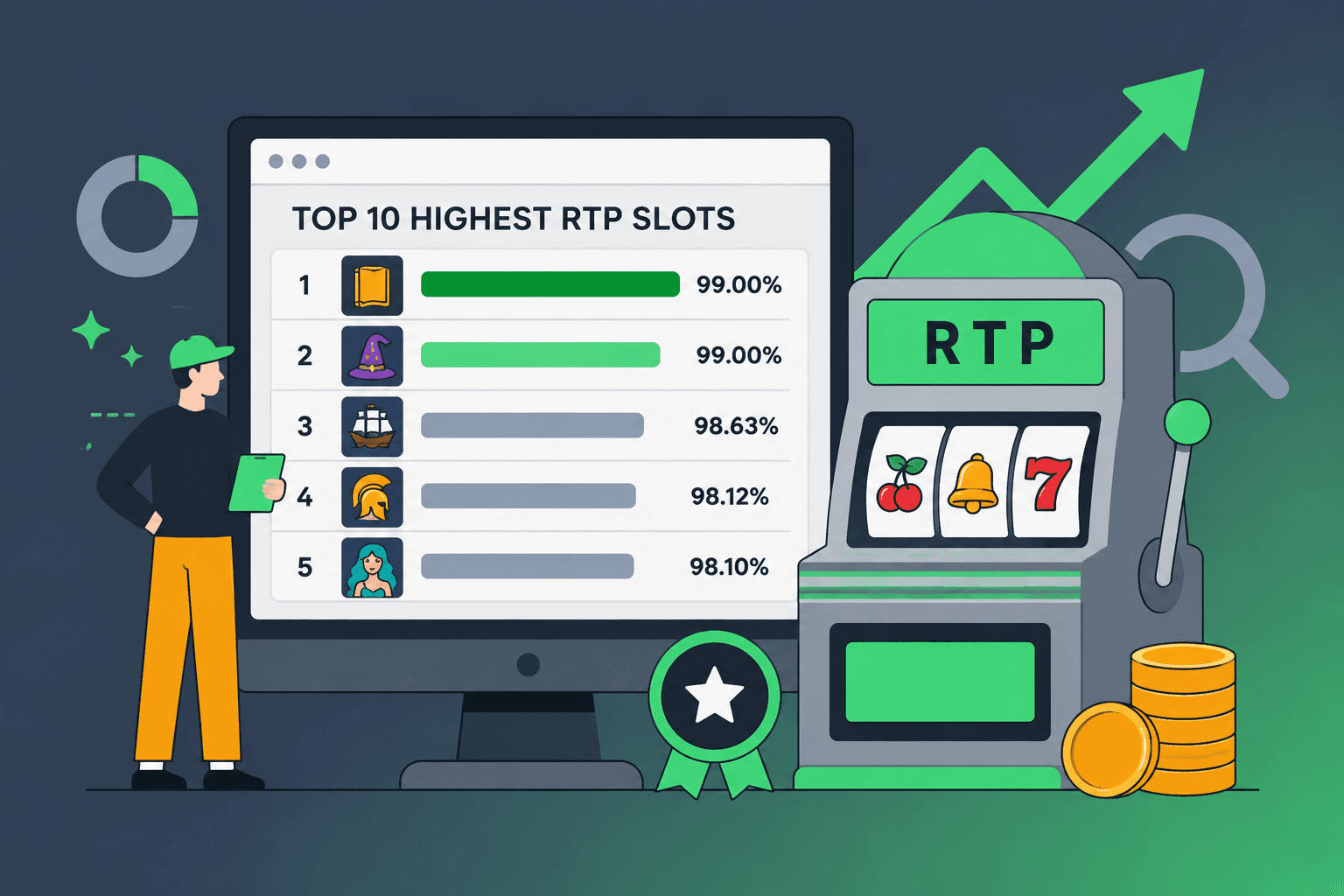
A 100% RTP slot would return all wagered money over time, eliminating the house edge entirely. These do not exist in licensed commercial casinos. Some video poker variants approach 99%+ RTP under perfect strategy, but standard slot machines are typically configured between 92.00% and 99.00%, with most falling between 94.00% and 97.00%.
[LAST REVIEWED: 2026-04-20]